Category: Packers and Movers

The Blogs related to packers and movers.

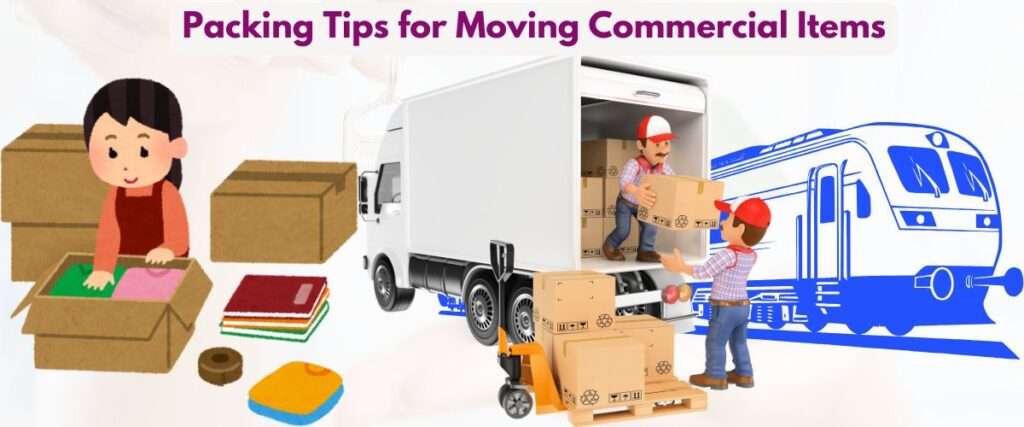
Packing Tips for Moving Commercial Items

Packing Tips for Moving Commercial Items

Label your items when packing them to help movers find them more easily in the truck and make unpacking easier later.

Specialty items often require customized solutions in order to be transported efficiently and in their original state. From delicate equipment to valuable artwork, commercial movers offer tailored strategies designed to ensure these assets arrive at their destinations safely and in excellent condition.

Packing

At a commercial move, packing properly to prevent damage during transit is of vital importance to minimize cost and time savings during the moving process. Professional movers offer packing services specifically tailored for fragile equipment like electronics, furniture and machinery as well as recommend suitable packing materials to use with each type of item they handle.

Step one in commercial packing involves identifying what needs to be packed. An inventory check prior to moving will help you better understand what items require moving and their associated costs; additionally, this will prevent any surprises during the moving process.

Packing requires sturdy boxes and protective wrappings, with each box clearly marked to identify its contents and reduce risk of mishandling or accidents that could cause damage. Furthermore, it is crucial that all equipment be adequately prepared before transport – disconnecting and wrapping electronics separately, disassembling furniture before wrapping, as well as securing and wrapping machinery to ensure its safe arrival at its final destination.

As another tip for effective organization, starting off by moving heavy and large items is key. They require more room and consideration when assembled than smaller, lighter pieces; additionally, these will be easier to handle once assembled. You can use crates to protect fragile equipment during transportation.

Last but not least, it’s essential that items be packed logically to help facilitate easy discovery when they reach their new home. Doing this also reduces damage risks while making unpacking easier once your reach your destination.

Packing effectively can significantly lower the risk of damage during a commercial relocation. By following these tips, you can ensure that all your assets reach their new homes undamaged. Effective packing practices can increase warehouse efficiency and decrease retrieval times once items have been shipped, simplifying delivery of your goods while increasing customer satisfaction. Effective packing not only reduces risk of damage, but can also lower shipping costs by optimizing space utilization and decreasing handling times – leading to higher profit margins and happier customers. Furthermore, effective packing reduces risks related to data loss which will improve reputation and build customer trust; making packing an investment worth making!

Loading

Proper loading and transporting procedures are vital in protecting fragile items during relocation. This involves employing techniques like padding, wrapping, and securing to minimize damages during transport as well as planning routes and modes of transport in advance to decrease accidents or delays.

Fragile items aren’t just delicate; they’re often very valuable. This may include family heirlooms, expensive artwork or antique furniture which add joy and memories to a new space – not forgetting their sentimental value which cannot be replaced. Preserving such treasures during moving and storage processes is crucial to their continued enjoyment for years to come!

Traditional moving methods involve multiple handlings during transport and storage-bound journeys, increasing the risk of damage or loss. Budd Van Lines’ revolutionary Load It Once Modular System revolutionizes this practice by eliminating the need for second trucks; dramatically reducing how often belongings are handled during moving and storage journeys and offering peace of mind throughout this journey.

Transportation

Transportation is an integral component of business operations, enabling the production and distribution of products and services across a wide variety of locations worldwide. There are various modes available – air, land (railway and road), water cabled to ships or satellites and spaceships among them.

Moving commercial shipments requires extensive preparation. To ensure its timely arrival at its destination, businesses should also factor in additional expenses such as packaging, insurance, warehousing costs, customs duties and administrative fees into the overall costs associated with relocation. These additional expenses should not be ignored and should be included when budgeting for relocation expenses.

The type of transport chosen depends on what, where and how much is being moved. In the US there are four primary modes: air, road, rail and sea transportation each offering their own set of advantages and disadvantages.

Trucking is the primary mode of freight shipment transportation in the US and accounts for more than half of total shipments annually. Trucks are particularly effective when used over short distances; however, delays due to traffic and weather can sometimes make this mode inefficient.

Train transport, which relies on railways to carry goods over long distances, offers several distinct advantages over trucks in terms of delivery schedule and weight restrictions. Furthermore, train transport has the capacity to transport heavier goods than trucks and is suitable for handling different kinds of freight cargoes.

Air transport involves flying goods directly to their destinations, which is ideal for urgent or high-value items, long distance moves and fast turnaround. Unfortunately, however, air freight transport is also the most costly form of freight transport and may not always be suitable.

Specialty items, like large machinery and artwork, require special handling during transit to avoid damage. A professional commercial mover can offer customized packing and crating solutions designed to minimize this risk of damage; providing various-sized crates specifically tailored for these delicate assets – or designing customized crates from scratch to protect delicate equipment – to reduce this risk and ensure their safe delivery to their new locations in perfect condition. They may even assist with installing these speciality items to minimize downtime and disruptions for your business.

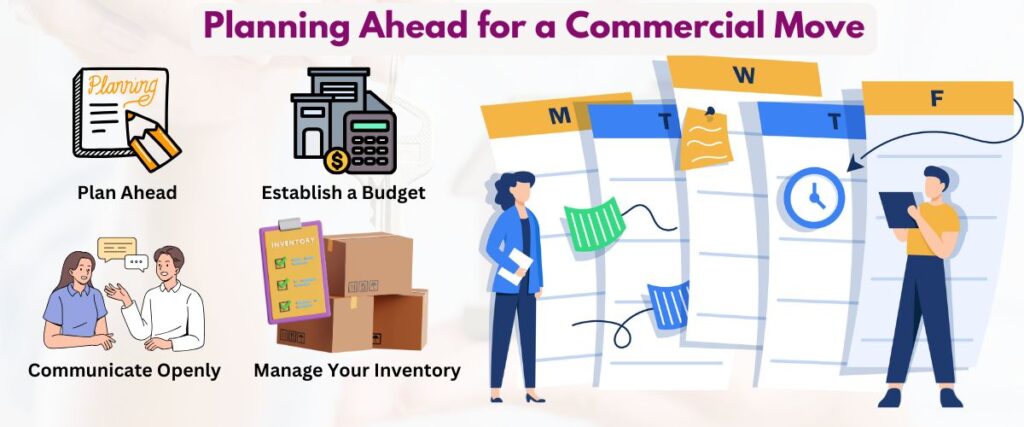
Planning Ahead for a Commercial Move

Planning Ahead for a Commercial Move

Commercial moves differ drastically from residential ones in many ways. They involve everything from moving corporate offices and factories to more intricate tasks like moving corporate campuses and production plants, all requiring extensive planning and strategic timing to ensure smooth operations during and after their move. Any disruption could severely hinder productivity or damage the operation altogether.

Tailored commercial moving services provide post-move support to minimize disruptions and ensure a seamless transition, such as helping to arrange furniture, unpack boxes quickly, and optimize workspace layout for greater efficiency.

Plan Ahead

Commercial moves require extensive preparation and strategic decisions, from setting an exact timeline, budgeting for expenses, minimizing disruptions and more. When businesses plan ahead for commercial moves they can reduce stress while cutting unforeseen expenses such as temporary storage fees for inventory or running out of packing supplies.

No matter whether it’s for an office move, warehouse relocation or manufacturing facility changeover, planning is key to a successful commercial relocation. An in-depth plan allows you to effectively oversee every step of the relocation process while minimizing downtime, protecting productivity levels and optimizing workspace design – not to mention meeting business goals such as expanding, rebranding or downsizing your operations.

Step one of planning any business relocation involves setting your goals for the move and how it will impact your business. This will enable you to establish a timeline and determine which items need packing. Furthermore, having an experienced project manager, move coordinator, and moving specialist on hand for assistance during this process is key in order to ensure everything runs smoothly.

An important step when planning a commercial move is choosing to schedule the actual move date during off-peak hours, such as outside of business hours or on weekends, in order to minimize disruption for employees and business operations. Filing requests for time off well in advance also can help facilitate smooth transition.

Professional movers can be invaluable assets when planning for a commercial move. Their knowledge of local area, building codes and equipment needs makes them invaluable resources. Knowing how to navigate tight spaces and crowded streets efficiently saves both time and money in the long run; additionally they have expert hands capable of handling even complex machinery with precision.

Before moving, be sure to notify utilities and service providers so they can switch services off or on. In addition, change the address on all websites, marketing materials and official documents as soon as you arrive in your new location.

Establish a Budget

Commercial relocations can be both complex and costly. To keep costs in check, it’s vital that a budget be established early. With Valley Relocation’s expertise on your side, managing your financial aspect won’t have to be an ordeal!

Spending the time to analyze the scope and inventory all assets will allow you to develop an accurate budget for a commercial move project. Furthermore, communicating openly with moving services and suppliers about anticipated expenses and cost-cutting opportunities can ensure everyone remains on the same page regarding costs – helping avoid unexpected surprises during this phase of your relocation journey.

When selecting a commercial mover, experience and track record should be paramount. Years in business indicate that an organization has learned from past errors while creating systems to prevent common industry pitfalls from cropping up again – something which will save both time and money during your move process.

Establish a contingency fund. Aside from negotiating with suppliers and searching for cost-cutting opportunities, it is crucial that you create an emergency reserve for unexpected expenses that arise during a commercial move – like parking permits, extra stairs or large equipment that needs disassembling and reassembly. By setting aside some savings early, unexpected expenses won’t derail the entire move process.

Revision your current policies regarding relocation expenses is key to making sure employees understand your expectations when it comes to relocating for work, and will also allow you to identify any gaps or deficiencies within your company’s relocation policy that need addressing.

Keep a file folder dedicated solely to the moving process where all quotes, invoices and receipts related to your move can be organized and easily referenced should any quotes or invoices come in higher or lower than anticipated so you can adjust your budget as necessary.

Communicate Openly

When it comes to commercial moving, keeping employees informed is an integral component. Doing this can reduce anxiety and stress levels as all staff are on board with what’s happening; scheduling regular meetings to discuss this transition and address any questions or voice any concerns can also be useful.

Communication will also ease anxieties related to transportation options, parking entitlements and other logistical details of a move. Engaging employees early on is another effective way of building acceptance; whether this involves inviting them to provide feedback on laboratory layout or voting on interior wall colors – showing their opinions are valued can go a long way toward increasing morale during a relocation.

Final tip: It is crucial to notify clients, vendors and other stakeholders well in advance of your move date so they have time to update records and prepare themselves for transition. Furthermore, having an emergency contingency plan ready could save time and money in case any unforeseen issues arise that would alter timeline or budget constraints.

After your move is completed, it’s wise to conduct a full inventory check and verify all items have been delivered without missing or damaged pieces. Furthermore, carefully examine your final invoice to ensure it matches with what was stated in your agreement with a business mover.

Manage Your Inventory

An inventory is crucial when planning a commercial move to ensure all equipment and supplies arrive in their intended locations. While moving companies typically provide lists of items to be transported, having your own will help track your assets more closely as well as assist with any insurance or liability claims during your transition into your new office space.

Assigning unique identifiers to each item on your moving inventory is crucial for smooth operation of a move and reduced misplaced or damaged items. Doing this also facilitates communication between yourself and white glove movers when special handling instructions need to be communicated.

If your inventory contains expensive or sensitive equipment, labelling it appropriately will help ensure the right boxes are loaded into the truck and that all sensitive equipment is handled accordingly. In addition, labeling allows for quick and easy identification during unpacking.

An effective inventory system should provide thorough details about each item being moved, from its location in the truck to any special handling requirements like disassembly or packing requirements. An inventory management software program can be invaluable in organizing all these details and streamlining the move process; additionally, real-time tracking of items during transit allows for improved efficiency and reduces costly mistakes.

An office move requires careful and precise planning and coordination. It often involves multiple parties working on it simultaneously, and it can become extremely expensive. Therefore, it’s crucial that all involved work quickly together on their part, communicate openly, and set a budget before beginning this endeavor in order to reduce risks of unexpected expenses while meeting all deadlines successfully. When hiring a moving company for this type of move it is key that you choose one with experience providing competitive quotes – this way any unexpected expenses won’t take over and overrun the schedule!

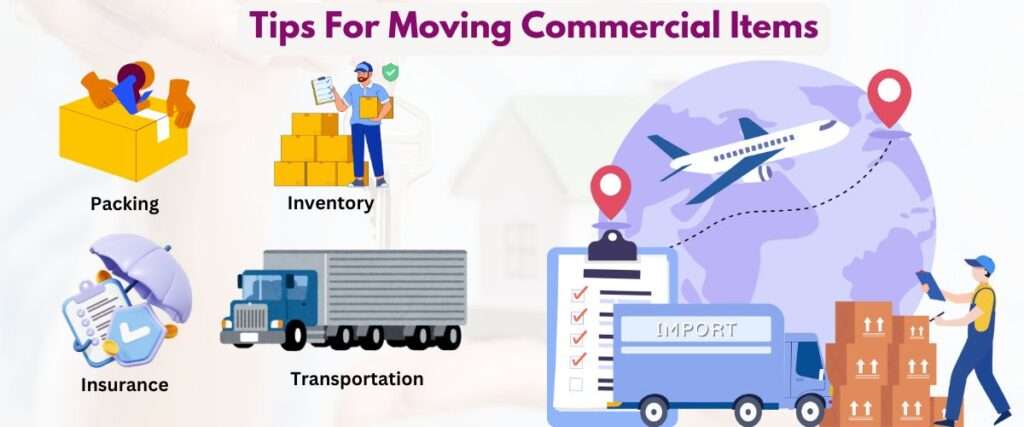
Tips For Moving Commercial Items

Tips For Moving Commercial Items

Commercial moves often necessitate special equipment and supplies that must be transported carefully; when moving such items, professional assistance should always be sought.

Employ a moving company that provides full-value insurance to protect against items lost or damaged during transportation. Also make sure to prepare an inventory list prior to starting the move process.

Packing

Your commercial equipment can often be large, awkward and heavy – which makes moving them challenging. Packing it for transport requires special consideration using appropriate materials and techniques so it reaches its destination intact.

At the forefront of any relocation plan is investing in high-quality packaging materials. Utilize durable boxes or crates designed for national and international relocations and don’t skimp on packing supplies – doing this will not only save money in the long run but will protect your items from being damaged during transit.

Heavy-duty bubble wrap should also be used to safeguard fragile items. It will provide extra protection from vibrations and compression, and could prove lifesaving in an accident situation. Be sure the bubble wrap covers all surfaces on an item; take extra caution if its unique shape involves multiple small parts that need protection.

When packing computers, be sure to disconnect all wires and pack them separately into different boxes. Also remove keyboards before packing in boxes or using a laptop bag if possible. Clearly label each box with their contents and owner name before moving them. Furthermore, backup data on external hard drives before clearing hard disks clean.

Large appliances require protective padding and strapping to stay secure on dollies or storage containers during shipping; otherwise they risk falling off trucks and collapsing during their journey, leading to significant damage and an expensive repair bill. Therefore, using appropriate tools and equipment when packing large bulky equipment such as commercial appliances is absolutely crucial.

Wood crates should also be used when shipping expensive equipment across national or international borders, especially if this equipment requires the maximum level of protection from accidental damages. Also drain lawn equipment and tools with gas/oil tanks as well as empty any removable parts from appliances before packing for shipping.

Inventory

Inventory refers to all goods and materials held for selling to generate profit for a business, from finished products ready for sale to work-in-process materials and raw materials. Inventory also serves as an invaluable tool for tracking sales and production trends; its information influences future purchasing decisions while helping reduce wasted inventory due to stockouts or delays in replenishment.

Businesses track inventory through various methods, such as spreadsheets such as Microsoft Excel or Google Sheets or home inventory apps like Sortly or MagicPlan. Whatever medium is chosen to record inventory, it is vital that each item be accurately identified and recorded so the moving process goes as smoothly as possible. A proper inventory list allows you to efficiently monitor packing progress as well as identify any damaged goods during transportation; additionally it assists with cost estimation, organization needs assessment and packing needs analysis.

As you prepare to move, it is essential to gather all the supplies required for inventory management – moving boxes, labels, markers and protective materials like bubble wrap or towels are among these supplies. Furthermore, consider creating a color-coding system to keep track of each box’s contents by room assignment; this can make finding and unpacking items much simpler when arriving at their new destination.

Inventory can be divided into four main categories, which are finished goods, raw materials, work-in-process and safety stocks. Finished goods refers to items ready for sale such as prepackaged fruit salad or personalized bathrobes. Work-in-progress inventory refers to items in the process of being transformed into finished products, such as silk fabric for custom wedding gowns or cotton for artificial flowers. Raw materials refers to components used in manufacturing products like leather belts or cotton artificial flowers. Finally, safety stocks include items not for sale but essential to continuing operations such as electrical backup supplies or lubricants.

Insurance

Insurance policies designed for moving companies tend to include extra coverage for damaged and lost items, providing an added layer of protection when damage costs, legal fines or settlements exceed standard policies like general liability or auto. Furthermore, business interruption insurance can help guard against financial losses should something prevent them from performing their regular work duties.

As with homeowners, commercial movers must conduct an inventory and valuation before hiring a moving company. High-value items may need more comprehensive coverage; shorter distance moves might only need basic protection. Also note that many homeowner and renter insurance policies won’t cover personal belongings during a move – check with your insurer first before signing any contracts with a moving company!

Some movers provide full replacement value insurance, which provides businesses with maximum asset protection. Although more costly than other options, this plan will cover any items lost or damaged during transit and pay out its current market value – ideal for valuable but light items. Furthermore, released and assessed value protection plans offer lower costs; released coverage goes up to 60 cents per pound while assessed values cover market cost rather than weight so this coverage option could work better when shipping expensive yet light objects like antiques.

Selecting the appropriate insurance will help your business mitigate risk and save money in the long run. In addition to purchasing moving insurance, consider securing additional business interruption and property damage coverage for vehicles, warehouses and employees of your company. For an all-encompassing approach, search for an insurer such as IAT TransGuard that provides tailored policies specifically designed to address the needs of your company – this way you can customize policies as necessary to secure special protection for valuable items like antiques or fragile goods.

Transportation

Commercial transportation is essential to businesses in order to transport goods efficiently and profitably. There are various modes of commercial transport available to businesses such as trucks, cargo ships and air planes, each of which has its own set of advantages and disadvantages; when selecting one it is essential that it fits your company’s specific requirements based on cost, speed of delivery and environmental impact factors.

Trucks dominate freight shipments by both tonnage and value. Their top 10 commodities by both weight and value include natural gas and other fossil fuels; gravel/grains/grains; gasoline; and mixed freight (principally electronics). Furthermore, high-value items like office equipment or motorized vehicles are transported via truck shipments.

In 2023, trucks transported more of the top 10 commodities by value than rail and ocean combined, as well as more by tonnage than rail and ocean combined.

Air transport is often the fastest mode of commercial transportation, yet can be costly due to weather and traffic delays. Air freight transport is best used when time-sensitive deliveries require fast delivery or high-value items need fast shipping; additionally it may also be suitable for transporting fragile items.

Cargo ships are the optimal transport method for heavy and bulky products like metals, agriculture produce, building supplies and other large volumes that cannot be easily accommodated by airplanes. They’re also great options for international trade if a company operates multiple locations around the globe that require delivery services that go door-to-door.

Water transport can be an economical and reliable means of shipping goods, yet may take more time depending on waterway infrastructure. It makes an ideal option for heavy or bulky items with reduced congestion and environmental impacts compared to road or air transportation methods.

Specialty items, including large machines and delicate electronics, require special handling procedures in order to be transported safely. Thankfully, specialty moving companies possess the experience needed to safely pack and transport these items, using custom crates designed specifically to prevent damages to these delicate pieces of machinery and electronics.

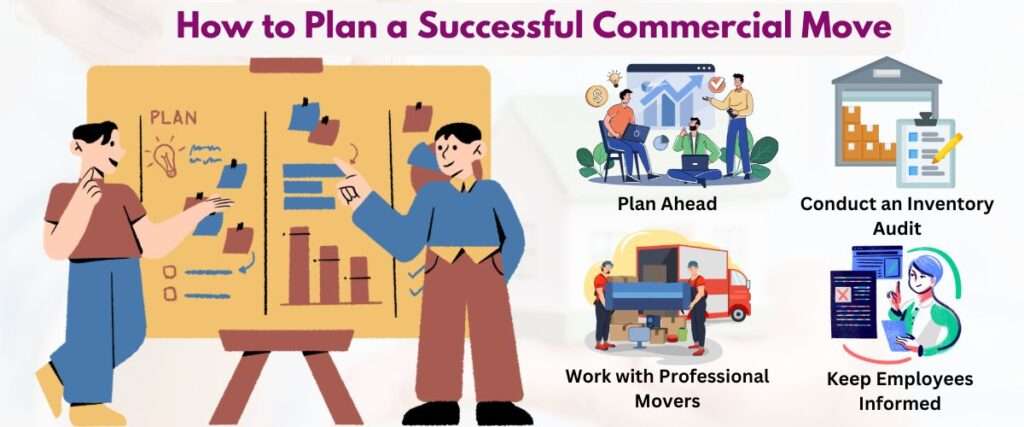
How to Plan For a Commercial Move

How to Plan For a Commercial Move

Commercial relocations are much more complex than residential ones, requiring business owners to select an effective day and location that won’t disrupt operations as much while providing employees with ample notice of what to expect during their move.

An experienced commercial moving company can make life much simpler for their clients. Their knowledge of compact city spaces and accommodating different pieces of equipment and furniture means they know just how to get the job done efficiently and expertly.

Plan Ahead

Commercial moves require extensive planning, so it is best to start early. First, set out a budget and establish milestones for hiring movers, purchasing boxes and making necessary improvements to your new space. Second, conduct an inventory audit of what needs to be moved or sold/donated/discarded in order to maximize planning ahead and prevent unexpected surprises from cropping up later on.

As part of your first subproject, one should analyze and plan out the layout of your new space by creating a floor diagram for individual offices and seating arrangements that accommodate employees’ needs. You should also solicit employee feedback and seek their input in this stage – giving them an opportunity to feel valued and offer suggestions as to how things could be improved.

At this stage, one key task should be updating your company website and social media profiles with its new address to prevent confusion among customers, vendors and any other parties trying to contact your organization.

Final preparations should include informing your team and developing plans to transition them to their new location. This should include discussing why and how it will happen as well as roles they should fill during this transition process. Notifying outside parties such as customers, vendors and landlords of an impending change will keep everyone up-to-date and minimize impact to your business. Select a reliable commercial mover who has experience working with businesses similar to your own as this will guarantee they have all necessary equipment and expertise required for handling this process effectively.

Conduct an Inventory Audit

An inventory audit involves conducting a comprehensive review of your company’s inventory and records to ensure their accuracy and compliance with regulations. A physical count to verify stock levels may also be conducted as well as comparison of documented quantities with actual items stored, while it also might involve an examination of your inventory management systems and processes, such as how you record inventory.

Conduct an inventory audit either in-house or through outsourcing services. No matter which approach is taken, it is vital that a dedicated team of employees work on this count to reduce errors and fraud while barcode scanners should also help speed up this process while eliminating human error. Ideally, teams of your most meticulous workers should complete this inventory count process.

Cutoff analysis is an integral component of inventory audits, and involves temporarily suspending warehouse operations so as to conduct a physical count of inventory items in stock. Timing should be set so as not to interfere with shipping and receiving activities, since cutoff analyses often reveal discrepancies which need resolving by auditors on hand.

Overhead analysis examines non-material costs that impact inventory costs, such as rent, utilities and insurance premiums. It helps identify and control expenses that erode margins to achieve profitability; perhaps by comparing FIFO/LIFO valuation methods and seeing where you might be overpaying.

Work with Professional Movers

Commercial moves demand different skills than residential ones. Not only must you manage equipment and furniture, but office documents may include sensitive information that must be handled securely. Hiring professional movers ensures your sensitive materials remain protected. Furthermore, these specialists have access to equipment not usually seen during residential moves like dollies and ramps; depending on the size of your business you may require additional manpower assistance when moving heavy pieces such as heavy equipment.

Most commercial moves take place outside of regular business hours to minimize disruptions and provide employees with ample notice of the move. Planning should begin well in advance to ensure a timely transition.

Commercial movers offer more than just packing, loading and transporting services – they also offer other specialized services like furniture disassembly/reassembly/storage solutions that can ease the burden of managing the move yourself while still guaranteeing optimal results for your business.

An experienced commercial moving company can also assist you in selecting an appropriate storage facility and handling all necessary paperwork associated with your move, as well as finding qualified movers that fit within your budget. When selecting a company, be sure to compare quotes before selecting one; compare any hidden fees that could drive up costs further, such as add-on fees. Finding reliable movers can significantly decrease moving expenses while making the process less stressful for yourself and your team.

Keep Employees Informed

Informing employees of the progress of your commercial move is vital to alleviating anxiety and maintaining morale. Create a timeline in your plan, then regularly provide updates with employees on when they should pack personal belongings for transporting, professional movers will arrive and what day one in their new space may bring. This information will enable employees to better prepare themselves for what to expect during a move – helping to avoid surprises!

An appointed contact will also provide support and address any potential concerns throughout the process, whether this person be team leader, HR representative or relocation specialist.

Communicating the benefits of the move is also critical. Emphasize how it will increase productivity, provide better access to amenities and networking opportunities, and create a more pleasant working environment – this will enable employees to accept it as an exciting step forward for the company.

As your project moves along, post photos of the workspace on your website or intranet so that employees can keep tabs on it and see its completion before moving day arrives. In addition, send weekly emails or post architectural renderings on physical bulletin boards in order to keep employees up-to-date.

Make your employees part of the moving process by soliciting their input on various matters during your move, from small suggestions about office layout to grand plans for hosting an introductory party – getting their participation will make the transition less stressful and allow for quicker integration into their new locations.

Choosing Moving Companies for Commercial Moves

Choosing Moving Companies for Commercial Moves

Selecting an efficient moving company for your commercial move can greatly speed up and streamline the relocation process while limiting disruptions. Professional movers are trained to safely transport high-value items and complex office equipment without incurring risk of loss or damage during transport.

At Nightingale Relocation Services, they typically work during evenings and weekends to minimize downtime for businesses. Furthermore, we offer comprehensive relocation services from inventory management to furniture installation.

Experience

When planning a commercial move, hiring an experienced company is vital to avoid costly errors that could cost both time and money. Furthermore, having access to packing/unpacking services ensures all belongings arrive intact at their new destination without interruption to business operations.

Professional commercial movers possess years of experience and the necessary expertise to conduct successful relocations with minimal interruption to your company’s productivity. Their trained personnel can expertly manage office suites, fragile items and bulky furniture without incurring damage. Furthermore, they offer special IT disconnect and reconnect services as well as custom crating for high-value items to protect during transport.

Full-service moving companies will visit your home to assess the size and scope of the move before providing an accurate cost estimate, which allows you to create a budget without overspending on moving services. Furthermore, hiring one during off-season periods such as weekdays or winter months could save money.

Finding the appropriate commercial movers can be challenging. Finding a company with years of experience and outstanding customer service is paramount. The top moving companies will work around your schedule, being willing to work weekends if necessary. They also employ project managers during moves to ensure everything runs smoothly; working closely with you to understand your business’s unique requirements while leading their team of movers efficiently pack, load, transport, unload your belongings. Consequently, this eliminates the need for costly packing supplies or back-straining lifting of belongings yourself.

Insurance

Moving can involve numerous risks, so it is crucial that movers have adequate insurance coverage. Policies can cover everything from physical injury and property damage claims, lawsuits arising from an accident in transit and lawsuits related to customer belongings being mishandled – as well as help you take advantage of bundled discounts to save money on their commercial policies.

Moving companies can access various forms of insurance coverage, including general liability, cargo indemnity and workers’ compensation policies. Which policy best fits your company’s type and risk exposure can vary; some choose a business owner’s policy (BOP), offering comprehensive protection in one package while others may opt for something more specialized such as an inland marine or auto/truckers liability policy – some insurers even provide combined policies with additional limits.

Insurance policies provided to moving companies will vary based on their size, locations and vehicle fleet. They may also depend on state laws as well as the nature of work they perform – for instance some states mandate minimum levels of general liability insurance and workers compensation coverage while others require a surety bond of at least $25,000 per location/vehicle.

Most people assume their office insurance will cover any damages sustained during a commercial move; however, this may not always be the case. Since some policies only cover specific forms of damage, it’s essential that any moving company you hire has adequate coverage prior to hiring them.

When selecting an insurance provider, be sure they are licensed in your state and meet all necessary coverage standards. In addition, do your due diligence by researching their industry reputation; an established insurer should have all of the expertise to help determine which policy will provide adequate protection for your commercial move.

Many insurance providers provide an online system that enables agents to sell policies directly to their customers without incurring extra paperwork or processes. In return, some offer referral fees or a percentage of sales; this could help boost revenue growth while supporting business operations.

Flexibility

Business relocations can be much more complex than residential moves, typically involving heavy machinery, delicate equipment and bulky furniture that requires special handling. Professional movers in your area are equipped to manage these challenges with experience, training and packing materials to transport your assets safely from point A to B while being familiar with local road systems, tunnels, bridges and traffic conditions.

Local commercial movers provide flexible operating hours that accommodate your business’s schedule, including moving it over weekends to reduce downtime and avoid potential revenue losses. Furthermore, these professionals have been specially trained to disassemble and pack heavy equipment like laboratory machinery or electronic devices without damaging expensive or essential items during transportation to their new destination. Furthermore, local commercial movers may assist in other ways as part of a move such as dismantling and reassembling cubicles, desks or television wall mounts if necessary.

Your business may contain products subject to industry standards or compliance, which require extra measures during transportation in order to prevent damage. Commercial movers have experience dealing with such complex matters and will ensure your move meets all necessary requirements so as to maintain productivity during its process.

Commercial moving companies employ experienced professionals who understand all the complexities involved with relocating a business. They can handle every aspect of the move efficiently and reduce downtime to save your company money over time. Furthermore, many offer insurance options that protect commercial goods in case of loss or damage.

Finding the ideal moving company can be challenging, but with research you can easily locate one to meet your specific needs. Be sure to choose a full-service commercial moving company equipped with equipment, insurance coverage and expertise in order to complete the move smoothly and on schedule. Also be wary of companies advertising “we do it all” services as these may lack specialized knowledge, equipment and personnel for handling commercial relocation.

Efficiency

An office move requires intricate coordination among many moving components and must take place quickly without disrupting employees, clients or customers. Local commercial movers specialize in expedited relocations for businesses of all kinds. Their customized moving solutions help ensure a seamless transition that maintains productivity while mitigating revenue losses during transition periods.

Commercial movers differ from residential movers by being equipped with the experience to move specialized equipment like IT infrastructure and delicate furniture safely from one location to the next. Their tools, materials, and trucks help transport items securely. In addition, commercial movers offer additional services for specialty items like artwork or antiques that residential movers don’t.

One of the main advantages of hiring a commercial moving company is their expertise in devising and executing an extensive moving plan. Their experts ensure every aspect of your move is addressed, reducing downtime for your business. Plus, they can schedule the move during off-peak hours or weekends for minimal impact to employees and customers.

Though your employees can help reduce costs by managing the move themselves, lifting heavy boxes and furniture without proper training could pose risks that could require costly workers’ compensation claims. Commercial movers are trained in heavy lifting techniques and could relieve them of this burdenful task.

Moving companies can also minimize downtime associated with commercial moves by strategically planning their process around your most critical moments for business. They can arrange off-peak hour moves so as to limit production disruptions and service disruptions, and prioritize unloading of essential items to ensure operations resume as soon as possible – thus helping limit customer and employee frustration and loss of revenue during transition periods. They may even help protect your brand from negative press associated with delays caused by the relocation.

How Commercial Shifting Benefits Businesses

How Commercial Shifting Benefits Businesses

Commercial shifting refers to the process of moving offices or business premises from one location to the next, an undertaking which must be carefully planned and carried out without disruption to productivity or client relations.

Relocating can provide several advantages to companies. These benefits may include improved market access, efficient space utilization and reduced operational disruptions.

Efficient Space Utilization

Efficient space utilization is an integral element of commercial shifting. It involves tracking and analyzing how various spaces -from offices, meeting rooms, desks and common areas- are being utilized so they meet organizational requirements. By gathering this data, companies can create more functional workplace environments while saving costs, improving productivity and increasing employee satisfaction.

Space management best practices can save businesses significant sums in expenses by identifying underutilized areas and eliminating them, leading to significant cost savings when it comes to real estate costs.

Space utilization should not be confused with occupancy, which measures how many people are present in an area. A conference room could have high occupancy but low utilization if only a handful of attendees use it frequently and use resources that could otherwise be better spent elsewhere. To achieve successful space utilization for your organization, it’s crucial that you understand its unique workspace so you can monitor metrics like daily peak utilization by business unit, average weekly usage, employee density etc. to track and measure appropriate metrics.

Reduced Operational Disruption

Shifting commercial operations is an opportunity to implement new technology and streamline workflows, while simultaneously decreasing operational disruption during the shift by having a backup plan in place. While disruptions cannot always be avoided, they can still be managed to mitigate their negative impact on operations and productivity by creating contingency plans, diversifying supply chains and resources, improving communication among teams, investing in backup systems/infrastructure, conducting risk assessments to identify any risks or threats, etc.

The COVID-19 pandemic was one of the many instances of disruptions to business operations that had far-reaching ramifications; their impacts can be felt far beyond any one location. Disruptions can have multiple negative outcomes ranging from reduced productivity and financial losses to reputational damage and trust issues; those affecting critical infrastructure may even cause physical damages to buildings, roads, or bridges.

Operational resilience consists of two separate capabilities, disruption absorption and recoverability. Previous research has established positive associations between these capabilities and operational efficiency; particularly strong associations are found when operating in disruptive environments. Our study builds on this by investigating the moderating role that disruption conditions may have on this relationship.

To address this question, we developed a formative measure of operational disruption comprised of nine items that represent independent unexpected events that cause operations disruptions. After collecting our data, we ensured there were no multicollinearity issues and all correlations fell below 2.0.

Our analyses indicate that both disruption absorption and recoverability are positively correlated with operational efficiency; however, under high disruption conditions the effects of disruption absorption are greater than recoverability. Our findings illustrate that managers may need to choose between various levels of resilience to maximize performance benefits. They suggest that disruption absorption and recoverability should not be seen as alternatives but as complementary strategies for operational resilience, while providing new insight into how various components influence operational efficiency, providing guidance for strategic investment decisions of firms faced with various disruption situations.

Enhanced Flexibility

Businesses experiencing rapid expansion or changing business needs can benefit from designing for flexibility to future-proof their spaces and reduce disruption associated with major renovations while creating environments responsive to evolving business practices and unexpected challenges. By prioritizing adaptable technology and infrastructure, commercial shifters can reduce costs associated with major remodels while creating environments which adapt as needs shift over time.

White-collar workers tend to seek flexibility through remote work arrangements; hourly shift employees require different forms of flexibility in order to remain engaged and productive at the workplace. To meet their demands, organizations can implement various employee scheduling solutions, such as compressed workweeks (with an eight-hour workday split across four 10-hour days), flexible start times (6 AM-10 AM), compressed workweeks with four 8-hour days each day shifted across four 10-hour days), split shifts (where workday is divided into multiple segments), or compressed workweeks where an 8-hour workday is spread out over four 10-hour days).

As part of designing for flexibility, one key element is making sure the underlying systems can adapt quickly to changing requirements, from adapting existing software applications or purchasing new ones with improved scalability and agility to employing employee scheduling software to increase worker engagement, productivity and job satisfaction.

Although it may seem counterintuitive, adding flexibility into frontline work arrangements for shift- and site-based employees can bring immediate advantages. According to the recent report entitled Shifting Expectations: Flexibility for Frontline Shift and Site Based Roles by Viva Energy, Worley South32 Unilever Crown Hanson shows how flexible work arrangements for shift and site based employees improve workforce engagement and productivity.

Reduced Costs

Reduced costs in commercial shifting are key to improving company profits. Cost reduction can be achieved through direct expense reduction, indirect cost cutting not directly related to production, and variable costs that vary based on production volume. It’s essential that costs are thoroughly examined in order to identify opportunities for improvement as well as direct cost shifting which occurs when project managers pass along additional expenses unintentionally to customers or suppliers.

Implementing a cost-cutting strategy is one way to gain competitive edge while creating a stable financial foundation that makes navigating volatile market conditions simpler.

How to Go About Commercial Shifting

How to Go About Commercial Shifting

Commercial shifting refers to the process of moving an organization from its current location to a different one, often in order to increase productivity and efficiency, optimize workflows, attract new clients and streamline operations. When choosing a hauler make sure they offer customer reviews and satisfaction rates before selecting one for you!

Commercial moving differs significantly from residential transportation in many ways, so it is crucial that your company selects an experienced team of commercial movers Los Angeles that meets its individual requirements.

Cost

Commercial relocation can be costly. This is due to the nature of its demands: special equipment, storage space, logistics services and staff are needed, along with reconfiguring office layouts, installing new technologies systems and funnelling work to minimize disruption. But this expense can be offset by hiring reliable business movers; make sure to research their sales history and customer service ratings before getting a quote and comparing against similar services; it would also be wiser if a hauler stationed nearby your business could make relocation planning and shipping costs easier while saving on costs associated with shipping costs.

Logistics

Relocating commercial operations involves reconfiguring workspaces and installing new technologies, which can increase efficiency and inspire innovation. Relocating also presents an opportunity to reduce costs and enhance employee satisfaction; however, the logistics surrounding commercial shifting are complex and should only be attempted with assistance from experienced commercial movers.

Logistics encompasses a set of processes designed to facilitate the movement of goods and materials from suppliers to customers, such as warehousing, transportation and distribution. Logistics management involves strategic planning for these activities while also coordinating information, materials and people to achieve supply chain goals.

An apparel retailer might receive clothing stock from designers and manufacturers for shipment into its distribution warehouse, where its logistics team may reorganize it to prepare it for storage and shipment to stores or a third-party logistics partner for further distribution.

Inbound logistics refers to how a company brings supplies into its facilities while outbound logistics involves sending finished products out for retail sale. Both processes involve various tasks related to inventory control, purchasing, material handling warehouse storage and transportation.

An efficient logistics system enables companies to effectively manage inventory and customer demand while increasing productivity and efficiency, decreasing operational costs, improving the customer experience, reducing delivery delays, returns, and rework, while simultaneously improving productivity and efficiency. Conversely, poor logistical processes result in dissatisfied customers and lost revenue for businesses.

Companies looking to reduce the environmental impacts of logistics should implement strategies designed to lower emissions. This might involve optimizing logistics to decrease fuel usage, switching over to renewable energy sources or installing green technology in warehouses or transportation networks. In addition, businesses should encourage partners and suppliers to adopt similar measures.

When searching for a commercial transporter, it’s essential to read their ratings and reviews as well as locate one with experience handling commercial shifts. Furthermore, an ideal transporter would be located close by so as to simplify planning and relocation processes.

A Comprehensive Checklist for a Smooth Moving Day

A Comprehensive Checklist for a Smooth Moving Day

Moving to a new home can be both an exciting and daunting experience. At Jaishwal Packers & Movers, we understand the complexities involved in relocating, whether it's across the street or across the country. To ensure a seamless transition, we've compiled a comprehensive checklist to guide you through every step of the moving process. With detailed planning and organization, your moving day can be stress-free and efficient.

Preparation Before Moving Day

1. Start Early
Moving requires meticulous planning, and the earlier you start, the smoother the process will be. Begin by setting a moving date and creating a timeline that outlines all the tasks you need to complete before the big day.


2. Declutter Your Home

Before you start packing, take the time to declutter your home. Go through each room and decide what to keep, donate, sell, or throw away. Removing unnecessary items will make packing easier and reduce the volume of things to move.

3. Gather Packing Supplies
Ensure you have all the necessary packing supplies, including boxes, bubble wrap, packing paper, tape, markers, and labels. Having the right materials on hand will make the packing process more efficient.

4. Create an Inventory List
Make an inventory list of all your belongings. This will help you keep track of everything during the move and ensure that nothing gets lost or left behind. It also aids in organizing your items when unpacking.

5. Notify Important Parties
Inform relevant parties of your move, including your employer, schools, banks, utility companies, and postal service. Update your address and arrange for the transfer or disconnection of services as needed.

6. Plan Your Move with Jaishwal Packers & Movers
Contact Jaishwal Packers & Movers to schedule your moving date and discuss your specific needs. Our team of professionals will provide you with a customized moving plan, ensuring that all your requirements are met.

7. Prepare an Essentials Box
Pack a box with essential items you'll need on moving day and the first few days in your new home. Include items like toiletries, a change of clothes, important documents, medications, and basic kitchen supplies.

8. Label Your Boxes
Clearly label each box with its contents and the room it belongs to. This will make unpacking easier and help the movers place the boxes in the correct rooms.

Packing Tips

1. Pack Room by Room
To stay organized, pack one room at a time. Start with the least used rooms and work your way to the most frequently used areas. This method ensures that you don't mix items from different rooms, making unpacking more efficient.

2. Use the Right Size Boxes
Use sturdy, appropriately sized boxes for different items. Heavy items like books should go in smaller boxes, while lighter items like bedding and linens can go in larger boxes. This prevents boxes from becoming too heavy to lift.

3. Protect Fragile Items
Wrap fragile items in bubble wrap or packing paper and place them in boxes with plenty of cushioning. Mark these boxes as "Fragile" to ensure they are handled with care.

4. Avoid Overpacking Boxes
Overpacking boxes can make them difficult to lift and increase the risk of damage. Keep each box at a manageable weight and ensure that the tops can be securely closed.

5. Pack Heavy Items at the Bottom
When packing boxes, place heavier items at the bottom and lighter items on top. This helps prevent damage to lighter items and keeps boxes balanced.

6. Seal and Label Boxes
Securely seal each box with packing tape and label it with its contents and destination room. This will make it easier for movers to place boxes in the correct locations in your new home.

Moving Day Checklist

1. Confirm Details with Jaishwal Packers & Movers
Confirm the arrival time of the moving crew and any specific instructions you may have. Ensure that you have provided accurate directions to your new home.

2. Protect Your Home
To prevent damage, lay down protective coverings on floors and walls. Use doorstops to keep doors open and protect door frames from scratches.

3. Coordinate with the Moving Crew
When the movers arrive, provide them with a tour of your home and point out any fragile or valuable items. Provide clear instructions on what needs to be moved first and any special handling requirements.

4. Keep Important Items with You
Keep important documents, valuables, and personal items with you rather than packing them in the moving truck. This ensures they remain safe and easily accessible.

5. Conduct a Final Walkthrough
Before leaving your old home, conduct a final walkthrough to ensure that nothing has been left behind. Check all rooms, closets, cabinets, and storage areas.

6. Supervise Loading and Unloading
Supervise the loading of your belongings onto the moving truck and the unloading at your new home. Ensure that boxes are placed in the correct rooms and check for any damage.

Post-Move Tips

1. Unpack Essentials First
Start by unpacking your essentials box and setting up the necessary items for daily living. This will make your first few days in your new home more comfortable.

2. Check for Damage
Inspect your belongings for any damage that may have occurred during the move. If you notice any issues, contact Jaishwal Packers & Movers to report the damage and discuss compensation options.

3. Update Your Address
Make sure to update your address with important parties, including banks, healthcare providers, and government agencies. This will ensure that you receive all important correspondence at your new home.

4. Set Up Utilities
Arrange for the connection of utilities at your new home, including electricity, water, gas, internet, and cable. Ensure that all services are functioning properly.

5. Explore Your New Neighborhood
Take some time to explore your new neighbourhood, including nearby shops, restaurants, parks, and other amenities. Getting familiar with your surroundings will help you feel more at home.

6. Get to Know Your Neighbors
Introduce yourself to your new neighbours and start building connections within your community. This can make the transition to your new home smoother and more enjoyable.

Conclusion

A successful move requires careful planning, organization, and attention to detail. By following this comprehensive checklist provided by Jaishwal Packers & Movers, you can ensure a smooth and stress-free moving day. Our team is committed to making your move as seamless as possible, and we are here to assist you every step of the way. Happy moving!

Top 10 Tips for a Stress-Free Moving Experience

Top 10 Tips for a Stress-Free Moving Experience

Moving can be a daunting task, filled with countless challenges and stressors. However, with the right planning and guidance, it doesn't have to be. Jaishwal Packers & Movers, with years of experience in the industry, share their top 10 tips to ensure a stress-free moving experience. These expert tips will help you navigate the complexities of relocation with ease and confidence.

Start Early and Plan Ahead

One of the most crucial steps to a smooth move is starting early. Procrastination can lead to a rushed and chaotic moving day. Begin planning your move at least two months in advance. Create a detailed moving checklist that outlines all the tasks you need to complete before, during, and after the move. This list should include everything from decluttering your home to booking professional movers and setting up utilities at your new place.

Prioritize Tasks
Breaking down the moving process into smaller, manageable tasks can make it less overwhelming. Prioritize these tasks based on their urgency and importance. For example, start by sorting and decluttering your belongings, then move on to packing non-essential items. This approach ensures that you stay organized and on track throughout the moving process.

Set a Timeline

Establish a clear timeline for each task on your checklist. Setting deadlines helps you stay focused and ensures that everything is completed in a timely manner. Allocate specific days for packing different rooms, scheduling moving services, and notifying relevant parties about your move.

Declutter and Downsize

Moving provides an excellent opportunity to declutter and downsize your belongings. Go through each room and decide what to keep, donate, sell, or dispose of. Decluttering not only reduces the number of items you need to move but also helps you start fresh in your new home.

Sort Items into Categories
Categorize your belongings into four categories: keep, donate, sell, and dispose of. Be honest with yourself about what you truly need and use. Items that you haven't used in the past year or that hold no sentimental value should be considered for donation or sale.

Organize a Garage Sale
If you have a significant number of items to sell, consider organizing a garage sale. This not only helps you declutter but also allows you to earn some extra cash that can be used for moving expenses. Alternatively, you can sell items online through platforms like eBay, Craigslist, or Facebook Marketplace.

Hire Professional Movers

While it might be tempting to save money by handling the move yourself, hiring professional movers can significantly reduce stress and ensure a smooth transition. Jaishwal Packers & Movers offer a range of services, including packing, loading, transportation, and unpacking, to make your move hassle-free.

Research Moving Companies
Take the time to research and compare different moving companies. Look for companies with positive reviews, proper licensing, and insurance. Obtain quotes from multiple movers and choose one that offers a balance between quality service and affordability.

Book Early
Movers can get booked up quickly, especially during peak moving seasons. To secure your preferred moving date and time, book your movers at least a month in advance. This ensures that you have the support you need on a moving day.

Create a Packing Plan

Packing is one of the most time-consuming tasks in the moving process. Creating a packing plan can help you stay organized and ensure that everything is packed efficiently and safely.

Gather Packing Supplies
Before you start packing, gather all the necessary packing supplies, including boxes, bubble wrap, packing paper, tape, and markers. Having the right materials on hand will make the packing process smoother and more efficient.

Pack Room by Room
To avoid confusion and ensure that items are packed systematically, pack one room at a time. Label each box with its contents and the room it belongs to. This makes it easier to unpack and find items in your new home.

Protect Fragile Items
Use bubble wrap, packing paper, or blankets to protect fragile items such as glassware, dishes, and electronics. Label boxes containing fragile items to ensure they are handled with care during the move.

Keep Essentials Accessible

Pack a separate box or bag with essential items you will need immediately upon arrival at your new home. This could include toiletries, a change of clothes, important documents, and basic kitchen supplies. Having these items easily accessible will make the first few days in your new home more comfortable.

Notify Relevant Parties

It's important to notify all relevant parties about your move to ensure a seamless transition. This includes updating your address with various organizations and individuals.

Change Your Address
Update your address with the post office to ensure your mail is forwarded to your new home. Additionally, notify your bank, credit card companies, insurance providers, and any subscription services of your new address.

Inform Utilities and Service Providers
Contact your utility providers (electricity, gas, water, internet, and cable) to schedule the disconnection at your old home and the connection at your new home. Also, notify other service providers such as your phone company, lawn care service, and any home security companies.

Update Personal Contacts

Inform friends, family, and any other important contacts of your new address. This ensures that you stay connected and receive any important correspondence.

Take Care of Legal and Financial Matters

Moving involves several legal and financial considerations that should not be overlooked. Addressing these matters in advance can prevent any last-minute complications.

Review Lease or Sale Agreements
Carefully review your lease or sale agreement to ensure you understand your responsibilities. If you're renting, check for any clauses related to moving out, such as required notice periods or cleaning obligations. If you're selling your home, confirm the closing date and any necessary preparations.

Update Insurance Policies
Notify your home and auto insurance providers of your move and update your policies accordingly. This ensures you have the necessary coverage at your new address.

Transfer School Records

If you have children, arrange for the transfer of their school records to their new school. This helps ensure a smooth transition and continuity in their education.

Prepare for Moving Day

Moving day can be hectic, but with proper preparation, it can go smoothly. Here are some key steps to take in the days leading up to the move.

Confirm Details with Movers
A few days before your move, confirm the details with your moving company. Ensure they have the correct address, contact information, and any special instructions.

Pack an Overnight Bag
Pack an overnight bag with essentials such as toiletries, medications, and a change of clothes. This will be especially useful if you're too tired to unpack everything on the first night.

Prepare Your Home
Before the movers arrive, ensure that everything is packed and ready to go. Clear pathways and remove any obstacles that could hinder the moving process.

Stay Organized During the Move

Staying organized on a moving day is crucial to ensuring everything goes smoothly. Here are some tips to help you stay on top of things.

Keep Important Documents Handy
Keep important documents such as your moving contract, inventory list, and contact information for your movers handy. This ensures you have everything you need in case of any issues.

Supervise the Move
Be present during the move to supervise the process and address any questions or concerns from the movers. This helps ensure that everything is handled properly and nothing is left behind.

Conduct a Final Walkthrough

Once everything is loaded onto the moving truck, conduct a final walkthrough of your old home to ensure nothing is left behind. Check all rooms, closets, and storage areas.

Settle into Your New Home

Once you've arrived at your new home, there are several steps you can take to make the transition smoother and more comfortable.

Unpack Essentials First
Start by unpacking essential items that you will need immediately, such as toiletries, kitchen supplies, and bedding. This will make your first few days in your new home more comfortable.

Set Up Utilities and Services
Ensure that all utilities and services are set up and functioning properly. This includes electricity, gas, water, internet, and cable.

Explore Your New Neighborhood
Take some time to explore your new neighbourhood and familiarize yourself with local amenities, such as grocery stores, pharmacies, and parks. This will help you feel more comfortable and settled in your new surroundings.

Take Care of Yourself

Moving can be physically and emotionally exhausting. It's important to take care of yourself throughout the process to avoid burnout.

Stay Hydrated and Eat Well

Ensure you stay hydrated and eat well throughout the moving process. Pack healthy snacks and meals to keep your energy levels up.

Take Breaks
Don't forget to take breaks and rest when needed. Moving is a marathon, not a sprint, and taking breaks will help you stay focused and energized.

Don't hesitate to ask for help from friends, family, or professional movers. Moving is a big task, and having support can make the process much more manageable.
Moving doesn't have to be a stressful experience. By following these tips from Jaishwal Packers & Movers, you can ensure a smooth and stress-free relocation. Happy moving!

The Future of Moving: Emerging Trends and Technologies

The Future of Moving: Emerging Trends and Technologies

The moving industry is undergoing a massive evolution, driven by technological advances and a heightened focus on sustainability and personalized services. Let’s explore how companies like Let’s Get Moving are navigating this changing landscape.

A growing trend is for moving companies to offer bundled service packages that include cleaning, home staging, and utility setup. This approach streamlines the moving process for clients and reduces costs.

AI & Machine Learning

While the number of Americans moving to new homes has declined significantly since 2024, tech innovations are reshaping the industry and improving customers’ experiences. These trends – including an emphasis on sustainability, personalized services, and digital platforms – are redefining what it means to be a mover, helping to create a streamlined, convenient, and customer-centric process that will benefit both service providers and their customers.
As an example of this trend, companies are integrating AI technologies into their operations to automate tasks and optimize processes. For instance, chatbots are taking care of initial inquiries, freeing up time for human agents to focus on complex questions. Route optimization algorithms are also being used to determine the best route for a particular move, which saves fuel and improves efficiency.
Additionally, many moving companies are recognizing the importance of sustainability and have started to adopt green practices. For instance, some are using reusable packing materials and switching to energy-efficient vehicles to reduce their carbon footprint. They are also offering a variety of flexible pricing tiers to appeal to customers who want to minimize costs during the transition period.
In addition to these technological advancements, a growing number of moving services are offering niche services that cater to unique customer needs. The emergence of these specialized services is indicative of the changing attitudes and expectations of modern consumers. According to a recent study by HireAHelper, Americans’ motivations for moving are shifting from financial factors such as inflation and housing unaffordability to family considerations like wanting more space or a better school district. In the wake of these trends, it’s vital for movers to offer customizable options and deliver a high level of customer service to compete in this increasingly competitive industry.

Digital Platforms

Moving companies are using digital platforms to streamline their operations and offer more personalized services. For example, they are introducing apps that allow customers to book movers with the tap of a button. They are also implementing automated chatbots to communicate with customers and answer frequently asked questions. This helps to reduce customer service costs and improve efficiency.
The rise of the gig economy is reshaping the industry workforce. Instead of hiring full-time staff, many companies are relying on an army of on-demand workers to handle peak demand. This allows them to scale up or down quickly and efficiently based on changing conditions. It also allows them to offer more flexible pricing options and improve customer satisfaction.
As a result, the one-size-fits-all approach to moving is becoming a thing of the past. Customers now expect customization and flexibility, and moving companies are responding by offering a variety of packages, prices, and options. Many are also switching to green practices by using recycled packing materials, energy-efficient vehicles, and waste reduction initiatives. This helps to minimize their carbon footprint and attract environmentally conscious customers.
While 2023 trends showed a continuing trend towards suburban and rural areas, with their large homes and access to outdoor activities, millennials have begun to move in larger cities that offer both career opportunities and quality of life amenities. Meanwhile, baby boomers are choosing smaller towns that provide a balance of both lifestyle and culture.
Moving companies that adapt to these emerging societal and economic changes will have a better chance of thriving in the future. By taking advantage of the latest technology and focusing on customer satisfaction, they can win over new and repeat customers alike.

Personalized Services

Personalized services are customer experiences that reflect the specific needs and preferences of each individual. This includes everything from using a customer’s name to suggesting products that match their buying and browsing history. Companies that successfully navigate personalization can reap a multitude of benefits including improved customer satisfaction, increased sales, and greater loyalty.
However, it’s important to remember that overdoing personalization can be a turnoff for customers. They may perceive it as invasive and feel like you’re stalking them. This can also cause them to stop engaging with your brand. To avoid this, businesses must make sure they’re using data in an ethical manner that respects the privacy of their customers.
This means making sure that personalization isn’t merely a marketing or analytics initiative but is embedded throughout the organization. This requires aligning departments such as customer service, IT, and data analysts and ensuring that they all work together to create unified profiles for each individual customer.
Personalization is an essential element of a customer-centric business strategy and should be a key priority for all stakeholders, especially those responsible for customer experience. By leveraging a customer-first mindset, prioritizing the unique needs of each individual customer, and creating unified profiles based on real-time data, businesses can deliver personalized experiences that increase engagement and revenue.

Sustainability

As sustainability becomes a major priority for many industries, the moving industry is taking note. Whether it’s using fuel-efficient vehicles and eco-friendly packing materials, encouraging donating unwanted items, or going paperless to reduce paperwork usage, these efforts are being rewarded by customers.
These sustainable practices reduce waste and carbon emissions by decreasing the need for landfills and fossil fuels. They also support a greater level of transparency and trust between moving companies and their clients.
The COVID-19 pandemic has also seen a shift in customer expectations and priorities, including increased demand for personalized experiences. This has led to the rise of specialized moving services that cater to specific needs. For example, many movers now offer virtual surveys, which allow consumers to send in videos of their homes and belongings for estimates. This reduces the need for physical contact and helps speed up the process.
Another emerging trend is the use of receiving services, which provide flexible delivery and pickup options for individuals and families with busy schedules. This enables them to avoid missing delivery windows and eliminates the need for them to be available at the time of shipment. It’s also an effective way to minimize transportation costs by keeping packages in storage until a convenient time to deliver them.
The future looks bright for the moving industry as these new technologies, trends, and innovations continue to reshape customer expectations and experiences. By embracing these trends, moving companies can provide a more efficient and responsive service that is designed around the unique requirements of each individual client. This is not only good for the environment but also for business growth as it increases the overall quality of customer experience.

Customer Satisfaction

Moving is a complex process, and it’s important for movers to deliver a seamless experience to their customers. Technology innovations like mobile apps for booking and real-time tracking streamline operations and boost customer satisfaction. Additionally, green practices like using reusable packing materials, encouraging donations of unwanted items, and investing in hybrid or electric vehicles demonstrate a commitment to sustainability.
Another key trend is the growing emphasis on customer support and engagement. Companies that prioritize these aspects can build trust and loyalty with their customers, which is essential for thriving in an industry where competition is fierce.
The use of technological tools for data analysis is also transforming the way moving companies operate. For example, AI allows them to predict busy periods with remarkable accuracy so they can staff accordingly and ensure they have enough resources to handle any workload. Additionally, route optimisation algorithms can help save time and fuel by optimising routes, which is great for the environment and aligns with sustainable business practices.
As housing market trends shape relocation demands, it’s vital for moving companies to remain flexible and adaptable. For example, offering storage solutions or extended services may be helpful in areas with high sales activity while focusing on speedy moves could be beneficial in slower markets. Additionally, staying up to date on changing regulations is necessary for ensuring compliance and maintaining a competitive edge.
These emerging trends are redefining the future of moving by creating more personalized, efficient, and customer-centric services. By embracing these technologies and committing to sustainability, moving companies can position themselves as leaders in their respective markets. And for those considering a move, choosing a company with a strong focus on these trends can ensure a stress-free and supportive moving experience.