
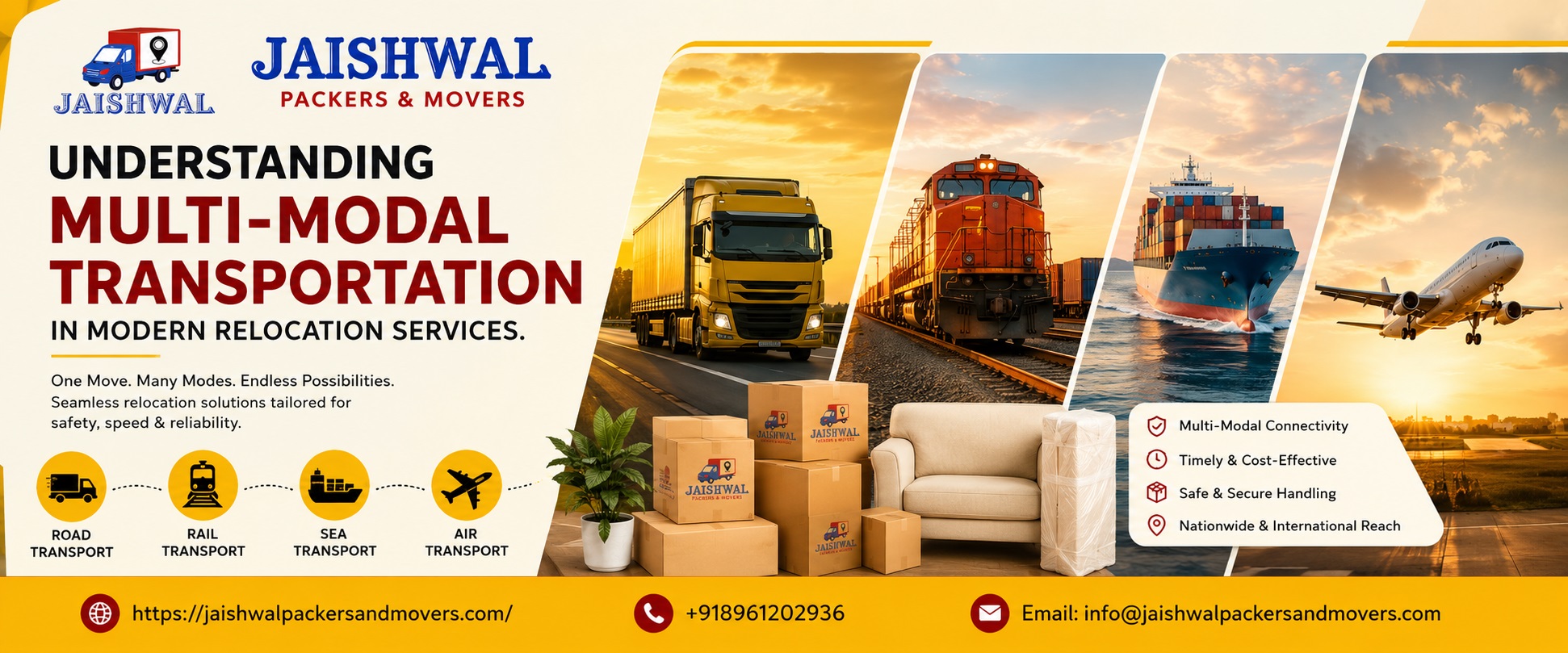
Shifting your home or office is never just about packing boxes. The real work happens after the boxes are sealed — when your goods have to travel from one city to another, sometimes across states, sometimes across the country. This is where multi-modal transportation comes in. It is one of those terms that sounds technical but is actually very simple once you understand it. And once you do, you will see why it has quietly become the backbone of how relocation companies in India move your belongings safely, faster, and at a fair cost.
In this blog, we will break down what multi-modal transportation means, why it matters for relocation, and how it is changing the packers and movers industry in India. We will also look at real numbers from government and industry sources to support our statements.
What Is Multi-Modal Transportation?
In plain words, multi-modal transportation means using more than one mode of transport to move goods from one place to another. Instead of relying only on a truck for the entire journey, your goods might travel part of the way by road, then switch to rail, and in some cases even move through a port or an airport before reaching the final destination.
Think of it like a relay race. One mode of transport carries the baton (your goods) for a certain distance, then hands it over to the next mode, which carries it further. The goal is simple — move the cargo in the most efficient, safest, and most cost-effective way possible.
Why Does This Matter for Household and Office Shifting?
When you are shifting your home or office, especially over a long distance, road transport alone can be slow, expensive, and exposed to delays from traffic, weather, or breakdowns. By combining road with rail or other modes, moving companies can:
- Cut down transit time
- Lower fuel and transport costs
- Reduce the risk of damage from long, bumpy road stretches
- Offer more reliable delivery timelines
This is exactly why a growing number of moving companies, including Jaishwal Packers and Movers, are shifting toward multi-modal solutions for long-distance relocations, rather than depending only on trucks.
How Multi-Modal Transportation Works in Real Relocation Projects
Let us say a family is shifting from Delhi to Bengaluru. A purely road-based journey would mean one truck driving the entire stretch, facing toll delays, traffic jams, and driver fatigue across nearly 2,000 kilometres. In a multi-modal setup, the same goods could be loaded onto a container, moved by rail for the bulk of the long-distance stretch, and then transferred onto a local truck for the last few kilometres to the new house.
This is often called the "first-mile and last-mile" approach — road handles the short distances at both ends, while rail or another bulk mode handles the long middle stretch.
The Role of Multimodal Logistics Parks (MMLPs)
India has been investing heavily in something called Multimodal Logistics Parks, or MMLPs. These are large facilities where road, rail, air, and sometimes waterway transport all connect at one point, making it easier to switch cargo between modes without delays. The Ministry of Road Transport and Highways has already awarded MMLPs at locations including Bengaluru, Chennai, Indore, Jalna, Jogighopa, and Nagpur, with the Jogighopa park in Assam built specifically to serve the northeastern region and neighbouring countries.
This matters for relocation because these hubs are exactly where companies like Jaishwal Packers and Movers Dunlop can plug into a faster, more organised network instead of relying purely on long-haul road trips.
Dedicated Freight Corridors Are Changing the Game
Alongside MMLPs, India has built Dedicated Freight Corridors (DFCs) — rail lines built only for cargo, separate from passenger trains. The difference these corridors make is significant. A report from KPMG India notes that moving coal over a 100-kilometre stretch on a traditional rail line used to take around 7 hours and 40 minutes; on the DFC, the same distance now takes just 4 hours, a nearly 50 per cent reduction in time. Freight trains on these corridors run at 60 to 70 kilometres per hour, compared to about 25 kilometres per hour on the older network.
For household and office shifting, this kind of speed improvement means goods spend less time in transit and reach their destination in a more predictable window.
Why the Numbers Matter: India's Logistics Backbone in Data
It helps to step back and look at the bigger picture. Multi-modal transportation is not a small experiment — it is central to how India is rebuilding its entire logistics system. Here are some figures worth knowing:
- India's logistics market was valued at around USD 243.82 billion in 2025 and is projected to grow to USD 429.02 billion by 2034, expanding at a yearly rate of about 6.48 per cent, according to IMARC Group.
- Roadways still dominate India's logistics movement, holding a 55 per cent share of the market in 2025, which is exactly why blending road with rail through multi-modal systems is so important for efficiency.
- India's logistics costs, which were once estimated at 13 to 14 per cent of GDP, have come down to roughly 10 to 10.7 per cent following close to USD 360 billion in infrastructure investment over the past decade, according to a CII and Knight Frank India study reported by Cargo Connect.
- The same study estimates that India will need around 215 to 216 large multimodal logistics parks by 2047 to handle freight demand, which is projected to touch nearly 28 billion tonnes by that year.
- Multimodal logistics parks connected to Dedicated Freight Corridors can cut door-to-door freight costs by as much as 43 per cent compared to relying only on road transport, per the same CII and Knight Frank report.
- India's ranking on the World Bank's Logistics Performance Index improved from 44th place in 2018 to 38th place in 2023, a sign of better infrastructure and service reliability, as highlighted by Invest India.
- India had 391.07 million registered vehicles as of 31 March 2025, with commercial vehicles making up 34.86 million, or about 8.9 per cent of the total, according to a NITI Aayog sectoral report on transport.
- The government has recently cut GST on freight and multi-modal transport services down to 5 per cent, alongside extended rail freight incentives, making rail-linked logistics parks more financially attractive, as reported by KPMG India.
These numbers tell a clear story. India is not just talking about multi-modal transport — it is actively building the highways, rail corridors, and logistics parks to make it work at scale. And as this infrastructure grows, relocation companies are among the biggest beneficiaries, because household and office goods are exactly the kind of cargo that benefits from a smoother, faster, multi-leg journey.
How This Benefits You as a Customer
You might be wondering how any of this affects your personal move. Here is the simple answer: when a moving company has access to rail corridors, logistics parks, and well-planned road networks, your goods are less likely to sit in a traffic jam for two extra days, less likely to face rough handling from repeated loading and unloading, and more likely to arrive within the time window you were promised.
This is part of the reason Jaishwal Packers and Movers Bansberia has been paying close attention to how routes are planned for long-distance moves — choosing the right combination of road and rail wherever it makes sense, rather than defaulting to road transport for every single shift.
What to Ask Your Moving Company
If you are planning a long-distance shift, here are a few questions worth asking your movers:
- Will my goods travel only by road, or is a multi-modal route being used?
- How many times will the goods be loaded and unloaded during transit?
- What is the estimated delivery window, and does it account for any rail or hub transfers?
- Is the cargo insured for the full journey, including any mode changes?
A transparent moving company will have clear answers to these questions and will be happy to explain the route plan to you in simple terms.
Final Thoughts
Multi-modal transportation is no longer a niche concept used only by big industries. It is steadily becoming part of how household and office relocations work across India, thanks to growing rail corridors, new logistics parks, and supportive government policies. The data backs this up clearly — lower logistics costs, faster freight movement, and a stronger national network are all part of this shift.
For anyone planning a move, especially over a long distance, it is worth choosing a mover that understands these changing dynamics. Whether your next shift is across the city or across the country, knowing how your goods will travel — and through how many modes — can make a real difference to your peace of mind.
