
AI-Powered Relocation: How Smart Technology is Transforming Packers and Movers Services in 2026
Let's be honest, shifting house or office has never been an easy job.
You spend weeks worrying about fragile items, calculating truck space, chasing quotes from five different movers, and then on moving day, something still goes wrong. A box gets misplaced. The truck is two hours late. You have no idea where your laptop charger ended up.
For decades, this was just the expected experience of relocation in India. But 2026 looks very different. Smart technology — driven by artificial intelligence, GPS tracking, IoT sensors, and digital platforms — is quietly but firmly changing how millions of Indians move their homes and offices. And the shift is happening faster than most people realise.
Why Relocation in India Is a Big Deal
Before we talk about technology, let's understand the scale of the problem it is solving.
India is urbanising at a remarkable pace. According to World Bank data via Statista, over a third of India's total population now lives in cities, and urban India had over 504 million residents in 2023 alone — a number that keeps climbing year on year. More people in cities means more people relocating for jobs, education, new homes, and growing businesses.
The numbers on the moving industry itself are staggering. According to ShiftingApp's India Packers and Movers Industry Report 2026, India's packers and movers industry reached ₹90,016 crore in FY 2025–26, growing 14.2% year-over-year. The sector facilitated 8.2 million relocations in that year alone — 6.1 million household moves and 2.1 million commercial and office shifts.
That is not a niche industry. That is a massive part of how India moves, literally.
And yet, for the longest time, this industry ran on phone calls, handwritten checklists, and a lot of guesswork. That era is ending.
The Technology Shift: What Is Actually Changing
AI-Powered Cost Estimation
One of the biggest frustrations customers faced was unpredictable pricing. You would call three companies, get three wildly different quotes, and still have no idea which one was fair.
AI is fixing this. Modern relocation platforms use machine learning models that factor in distance, volume, floor level, item category, traffic patterns, and seasonal demand to give accurate estimates within minutes. There is no more haggling in the dark.
ShiftingApp's 2026 industry data shows that customers using digital platforms report 28% lower costs due to price transparency, compared to those who book offline. That is a significant saving — especially for a family moving cities.
Real-Time GPS Tracking of Your Belongings
The most visible tech upgrade in relocation is GPS-enabled real-time tracking. You book a move, and instead of waiting and wondering, you watch your belongings on a map.
Fleet operators across India have rapidly adopted this technology. As reported by Autocar Professional, fleet operators in India have already reported fuel savings of 10–15% after adopting IoT-enabled telematics systems — and the same systems allow precise tracking of vehicle location, route deviations, and delivery timelines in real time.
This matters for customers. You know where your truck is. You know if it stopped. You get notified when it is close. The anxious "did they leave yet?" call to the driver is becoming a thing of the past.
IoT Sensors for Goods Protection
Beyond location, IoT sensors are now being used to monitor the condition of goods in transit — not just where they are, but how they are being handled.
Shreyasweb Media Solutions notes that IoT devices can continuously monitor conditions such as temperature, humidity, shock, and tilt during transportation. For valuable furniture, electronics, artwork, or lab equipment, this is a game-changer. If a package is dropped or exposed to moisture, the sensor logs it.
For customers, this means accountability. For movers, it means an incentive to handle things carefully.
Digital Inventory Management
Ask anyone who has shifted homes, and they will tell you: knowing what you have packed and where it is on moving day is half the battle.
Smart packers now use QR-code labelling and digital inventory apps to tag every box before it leaves your home. Each box gets a code, a photo of its contents, and a destination room assigned in the app. When it arrives at the new location, scanning the code tells the team exactly where it goes. No more "which box has the kitchen stuff?" moments.
This is a small but genuinely life-changing innovation for anyone who has moved.
The Numbers Tell the Story
The technology adoption in India's logistics and relocation space is not just anecdotal — the data backs it up strongly.
1. India's Logistics Automation Market Is Booming
According to IMARC Group, India's logistics automation market was valued at USD 1,877 million in 2024 and is projected to reach USD 8,068.7 million by 2033, growing at a CAGR of 15.7%. This includes AI, robotics, IoT, and smart tracking technologies being embedded across the sector.
2. Digital Bookings Are Surging
ShiftingApp's 2026 report notes that digital platforms captured 23% of total relocation bookings in 2025 — up sharply from just 11% in 2023. By 2030, that share is expected to reach 45%. Customers are clearly moving online.
3. AI-Augmented GPS Trackers Are Growing Fast
Coherent Market Insights data shows that deployments of AI-augmented GPS trackers rose by over 31% in 2025, with Asia-Pacific leading in growth, driven by India's expanding automotive sector and government-backed smart city programmes.
4. Online Booking Is Dramatically Better for Customers
Digital platform customers report 45% fewer complaints and 32% higher satisfaction scores compared to those who booked offline, per ShiftingApp's industry research. Average booking time has dropped from 2–3 days (offline) to just 8 minutes (online).
5. India's Logistics Sector Is Becoming a Global Force
India has jumped to the 38th position in the World Bank's Logistics Performance Index (LPI) 2023, up from 44th in 2018 — a recognition of improved infrastructure, digitised customs, and better end-to-end logistics performance across the country.
6. The Overall Market Is Massive and Growing
According to IMARC Group's logistics market report, India's logistics market reached USD 243.82 billion in 2025 and is projected to touch USD 429.02 billion by 2034, growing at a CAGR of 6.48%. The relocation sector is a key part of this ecosystem.
7. E-Commerce Is Accelerating Logistics Tech Adoption
India's e-commerce sector is projected to grow at 18% per annum to reach USD 325 billion by 2030, per Invest India. This rapid growth is forcing the entire logistics and relocation supply chain to adopt smarter, faster, technology-driven processes.
8. Urban India Is Driving Relocation Demand
India's urban population is projected to reach 36.87% of the total population by 2025, per World Bank estimates. The country is expected to add 50 million new urban residents by 2030, according to ShiftingApp's forecast data — creating sustained demand for professional, tech-enabled relocation services well into the next decade.
How Trusted Movers Are Using These Tools
Technology on its own does not move furniture. People do. The best relocation companies in 2026 are those that combine smart tools with trained, professional teams.
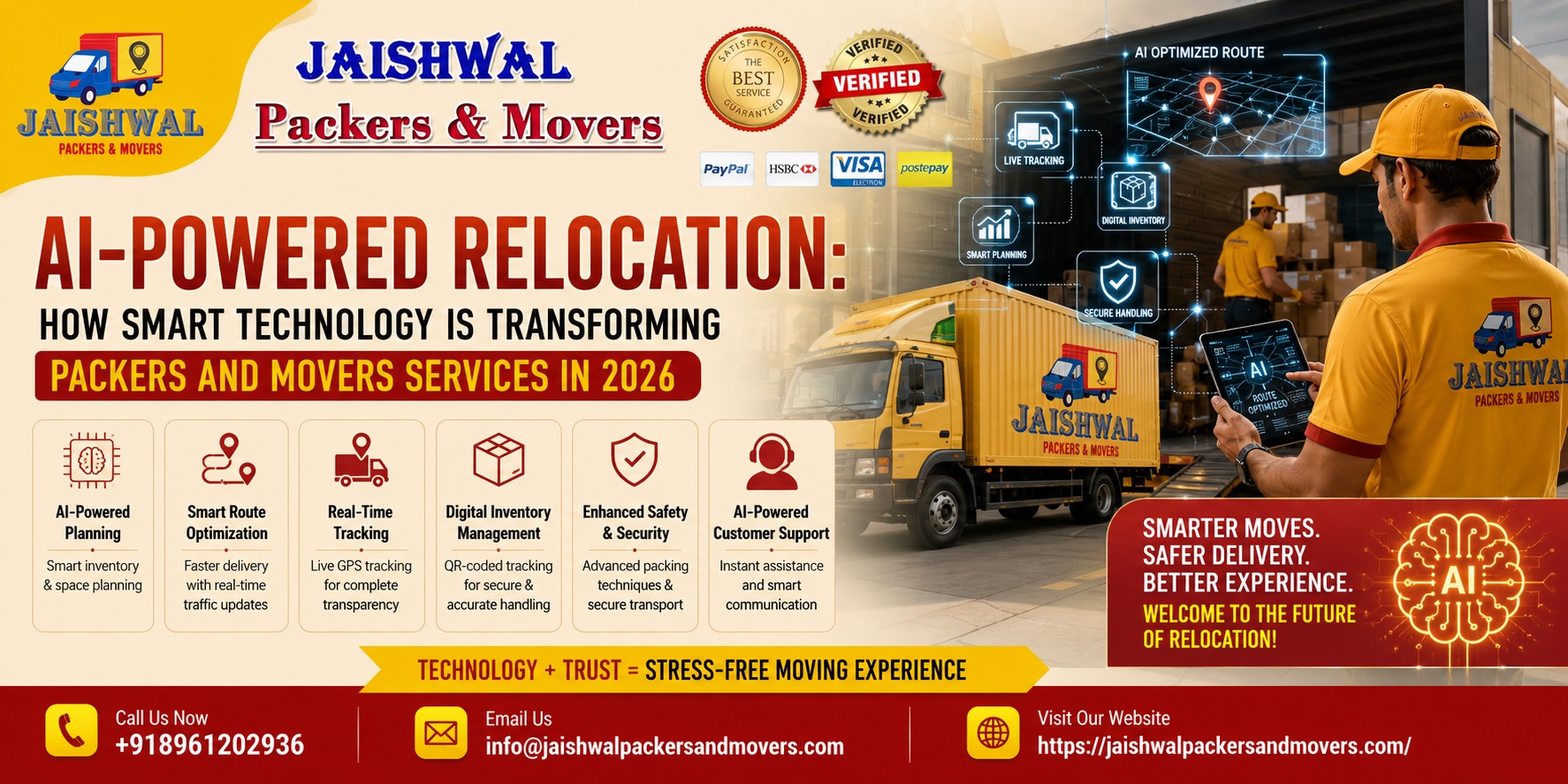
Jaishwal Packers and Movers is a strong example of how established relocation companies are embracing this transformation. By integrating digital booking, real-time tracking, and pre-move virtual surveys into their service model, they have modernised what the customer experience looks like from the very first inquiry. Customers get an accurate quote online, track their consignment on a live map, and receive a digital inventory report at the destination.
This kind of end-to-end approach — where technology supports every touchpoint — is what separates a professional move from a stressful one.
Virtual Surveys: The Pre-Move Revolution
One innovation worth calling out separately is the virtual pre-move survey.
Traditionally, a relocation company would send someone to your home to estimate volume and quote a price. That took time, added cost, and was often inaccurate anyway.
Today, companies use video calls or AI-powered scanning apps where you simply walk through your home on camera. The software analyses room dimensions, item types, and volume automatically and generates a quote — often more accurately than an in-person visit.
This is not just a convenience feature. It reduces no-shows, makes the process faster for customers in remote cities, and cuts the estimation time from a day to under an hour.
Chatbots, Customer Support, and AI Assistance
Moving involves dozens of small questions. What is the cancellation policy? Will you pack the TV? Can you store items for a week before delivery?
AI-powered chatbots on relocation platforms now handle these queries instantly, 24 hours a day. For customers calling at 11 pm because they just remembered something important, this is genuinely useful.
More advanced systems use natural language processing (NLP) to understand nuanced questions and route complex ones to human agents — while handling routine queries automatically. This reduces wait time, improves response quality, and frees up staff for tasks that actually need human judgment.
Predictive Route Optimisation
India's road conditions are notoriously unpredictable. Traffic jams, road closures, monsoon flooding — all of these can turn a 4-hour move into an all-day ordeal.
AI-powered route optimisation tools now factor in live traffic data, weather forecasts, road conditions, and historical patterns to find the fastest, safest route for each consignment. As noted in the Indian Transport and Logistics News, AI is beginning to move India's logistics system toward becoming a predictive, connected network — defined less by firefighting and more by foresight.
The result for relocation customers is simpler: your stuff arrives faster, and you get an accurate time estimate, not a vague window.
What This Means for You as a Customer
Here is the practical takeaway from all of this.
When you are planning a household or office move in 2026, the gap between a tech-enabled mover and a traditional one is large — and measurable. A tech-enabled company will give you:
- An accurate quote in minutes, not days
- A QR-coded digital inventory of every box
- Real-time GPS tracking from pickup to delivery
- IoT monitoring to ensure goods are handled safely
- A digital receipt and post-move report
A traditional mover gives you a verbal quote, a handshake, and a phone number to call if things go wrong.
The difference is not always about price. It is about control, visibility, and peace of mind during a move.
The Road Ahead: What 2026 and Beyond Looks Like
Jaishwal Packers and Movers Chandannagar and other forward-thinking relocation companies are already investing in the next wave of technology — and it includes some exciting developments.
Drone-based pre-move surveys are being piloted in large residential complexes where individual flat access is time-consuming. Blockchain for move contracts is being explored to create tamper-proof digital agreements and transparent billing. Augmented reality (AR) room planning tools let customers virtually arrange furniture in their new home before the truck even arrives.
The logistics automation market in India is forecast to grow at 15.7% CAGR through 2033. The moving industry is a direct beneficiary of this investment wave.
In the near term, the more immediate changes — AI pricing, GPS tracking, digital inventories, and virtual surveys — are already here and already making moves better. By 2030, online booking alone is expected to capture 45% of all relocation bookings in India, a near-doubling from today.
Final Thoughts
Shifting home or office used to mean bracing yourself for chaos.
In 2026, it does not have to. The technology is here. The platforms are built. The tracking is live. And the best companies in the relocation space, including Jaishwal Packers and Movers Hooghly, are using all of it to give customers something they rarely got before: confidence.
Confidence that their belongings are safe. Confidence in the price they were quoted. Confidence that someone, somewhere, knows exactly where their sofa is right now.
That might sound like a small thing. But if you have ever spent a moving day not knowing any of those things, you know it is not small at all.
