
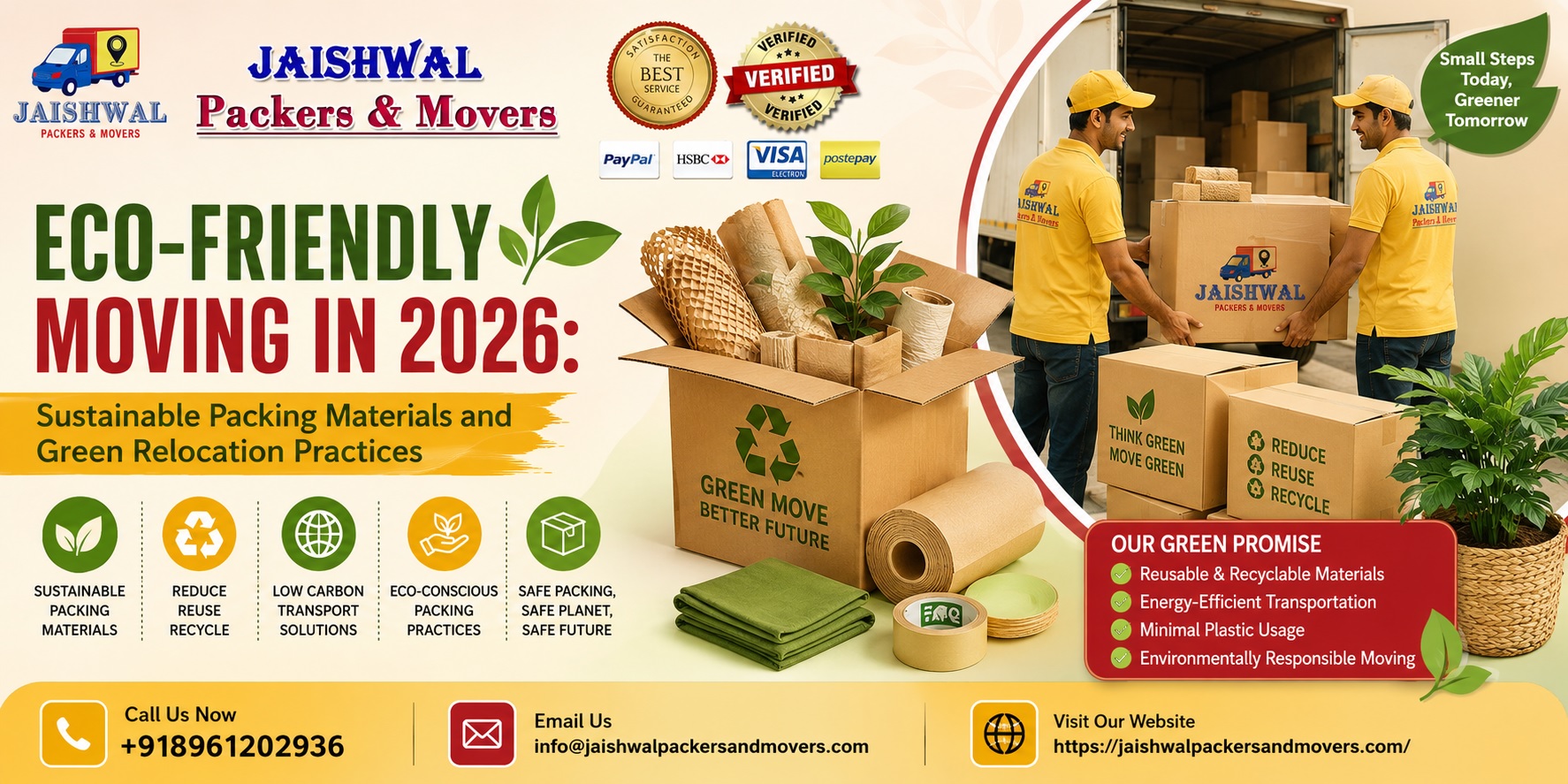
Eco-Friendly Moving in 2026: Sustainable Packing Materials and Green Relocation Practices
You are about to move. You have got boxes to pack, stuff to sort, and a truck to book.
But here is a question most people never stop to ask: What happens to all that plastic wrap, bubble wrap, and tape after the move is done?
The honest answer? Most of it ends up in a landfill.
India generates nearly 3.90 million tonnes of plastic waste every year — roughly 10,689 tonnes every single day — according to the CPCB Annual Report 2022–23. A large chunk of that comes from packaging. And with India's packers and movers industry now handling 8.2 million relocations per year, the environmental cost of moving is real and growing.
The good news? You can do this differently. In 2026, eco-friendly moving is no longer a niche idea — it is a practical, affordable choice that more and more Indian families and businesses are making.
This guide breaks it all down for you — what to use, what to avoid, and how to make your next move greener from start to finish.
What Is Eco-Friendly Moving and Why Does It Matter in India Right Now?
Eco-friendly moving means making deliberate choices during a relocation that reduce waste, cut carbon emissions, and leave less damage on the environment. It covers everything — the materials you pack with, the vehicle that transports your goods, the route it takes, and how you dispose of leftover packaging.
Here is why it matters more than ever in India today.
India is now officially the world's largest contributor to plastic waste, releasing an estimated 9.3 million tonnes of plastic into the environment annually, according to a 2025 study published in Nature. That is roughly one-fifth of the world's total plastic waste — more than any other country.
At the same time, the transport sector in India accounts for 14% of the country's total greenhouse gas emissions, with road vehicles — including the trucks used by packers and movers — contributing the overwhelming majority of that share.
Every relocation adds to both of those numbers. Or, if done right, it does not have to.
The Real Environmental Cost of a Standard Move
Before we get to solutions, let us be honest about the problem.
A typical household move in India involves:
- Multiple rolls of plastic bubble wrap
- Metres of non-recyclable plastic tape
- Dozens of styrofoam pieces for fragile items
- Single-use cardboard boxes that end up torn and discarded
- A diesel truck making one or more long-distance trips
Most of this packaging is used once and thrown away. And here is the critical part — according to a 2023 report by NITI Aayog, only 17% of Indian households practice full waste segregation. That means the packaging from your move almost certainly does not get properly recycled.
Add to that the emission load from transport. Medium and heavy-duty trucks — the same vehicles used in every commercial relocation — are responsible for 44% of India's total transport sector emissions, despite making up just 3% of all vehicles on the road.
Now multiply that across 8.2 million moves per year. The numbers become staggering.
But here is the flip side. The India green packaging market, valued at USD 9 billion in 2024, is projected to reach USD 57.2 billion by 2033 — growing at a CAGR of 22.5%. Sustainable alternatives are already here. They are affordable, widely available, and easy to use. All that is needed is the decision to choose them.
Best Eco-Friendly Packing Materials to Use in 2026
This is the practical heart of the guide. Here is exactly what to swap, what to use instead, and why it works.
1. Swap Bubble Wrap for Corrugated Paper or Honeycomb Wrap
Bubble wrap is the default choice for most people packing fragile items. But it is made from low-density polyethene — one of the hardest plastics to recycle — and it rarely makes it to a recycling facility.
What to use instead:
- Corrugated paper rolls — strong, biodegradable, available online and at most stationery stores
- Honeycomb paper wrap — excellent cushioning, made from recycled paper, fully compostable
- Old newspaper — free, surprisingly effective for crockery, glasses, and smaller items
Your grandmother used newspaper. She was ahead of her time.
2. Replace Plastic Tape with Paper (Kraft) Tape
Nobody thinks about tape. But a standard household move can use 10–15 rolls of plastic tape, none of which is recyclable.
What to use instead: Kraft paper tape or water-activated tape. It is just as strong, fully recyclable, and available on Amazon, Flipkart, and most office supply stores for roughly the same price.
3. Use Recycled or Reused Cardboard Boxes
Fresh cardboard is not the enemy — the problem is discarding it after one use. Reusing or recycling boxes is the greener choice.
Practical tips:
- Ask at local grocery stores, bookshops, or D-Mart outlets — they give away sturdy boxes for free
- Look for boxes specifically made from post-consumer recycled cardboard
- After your move, flatten them and hand them to a kabadiwala or a recycling centre
4. Try Biodegradable Packing Peanuts
Styrofoam packing peanuts are one of the worst environmental offenders — they break into tiny particles, float into waterways, and take centuries to decompose.
What to use instead: Cornstarch or wheat starch packing peanuts. They dissolve completely in water, are non-toxic, and work just as well. These are now available from eco-packaging suppliers across India.
5. Wrap with What You Already Own
This is the simplest and most cost-effective green packing method — and it requires zero purchasing.
Use towels, bed sheets, soft clothing, and cushion covers to wrap fragile items. Pillowcases work brilliantly for oddly shaped objects. You are essentially packing two things at once, using no additional material whatsoever.
6. Rent Reusable Moving Crates
This is the most efficient option of all. Reusable plastic crates are sturdy, stackable, and protect your goods better than cardboard. You rent them from your moving company, use them for the move, and return them after unpacking.
Zero waste. Zero mess. And often cheaper than buying boxes.
Green Relocation Practices That Go Beyond Packing
Choosing better materials is important — but eco-friendly moving goes further than what you wrap your dishes in.
Declutter Before You Pack — Ruthlessly
The most effective environmental action before any move is to move less stuff.
Go through every room. Set aside everything you have not used in the past year. Donate it to an NGO, sell it on OLX or Facebook Marketplace, or give it away to neighbours. Every item you remove from the move is one less thing to pack, one less thing to transport, and one less thing to unpack.
Fewer items = smaller truck = less fuel = lower emissions. The math is simple.
Choose a Green-Conscious Moving Company
Not every mover operates the same way. When requesting quotes, ask these questions directly:
- Do you offer reusable packing crates?
- Do your vehicles have fuel-efficient routing software?
- What do you do with leftover packing materials?
A company like Jaishwal Packers and Movers understands that clients today care about these things. Asking the question is itself a signal that changes industry behaviour.
Consolidate All Trips — Plan the Route Smartly
One of the biggest avoidable emission sources during a move is poor logistics — half-empty trucks, unnecessary detours, multiple trips that could have been one. A well-planned move gets everything in the fewest possible vehicles, taking the most efficient route.
If you are moving locally and have fewer items, consider whether a smaller vehicle or even a tempo suffices. Bigger is not always better.
Go Completely Paperless
All of the documents involved in a move — inventory lists, insurance forms, payment receipts, delivery confirmation — can be handled digitally today. Ask your moving company to use email, WhatsApp, or an app for all communication.
This eliminates printed paperwork entirely and also gives you a cleaner, searchable record of the entire move.
Dispose of Hazardous Items Before Moving Day
Before a move, many people encounter things they want to discard — old batteries, broken electronics, expired medicines, leftover paints, chemicals. Do not put these in general waste. India has a growing network of certified e-waste collection centres and hazardous waste disposal points.
Check with your municipal corporation or visit CPCB's registered e-waste recycler portal to find the nearest facility.
Eco-Friendly Office Relocation: A Growing Need
Corporate India is moving fast. The packers and movers industry recorded a 31% increase in GCC (Global Capability Centre) office setups in FY 2025–26, particularly across Bengaluru, Hyderabad, and Pune. Office relocations generate significantly more waste than household moves — and they happen on tighter timelines with less individual oversight.
Conduct a Pre-Move Asset Audit
Before any office move, audit every item in the workspace. Old desktops, printers, cables, furniture, and stationery that are no longer needed should be donated to schools, NGOs, or sent to registered e-waste recyclers.
Use Reusable Crates for All Office Items
Files, documents, small appliances, stationery, and IT accessories can all be packed in reusable plastic crates. No cardboard needed. This is already standard practice among corporates working with organised movers like Jaishwal Packers and Movers Dunlop, and it saves both money and waste.
Replace Printed Labels with QR Codes
Every box in a large office move typically gets a paper label. Replace these with QR code stickers linked to a shared digital inventory. Every team member can access the list from their phone, update it in real time, and locate items without digging through piles of boxes.
India's Policy Push: The Government Is Moving Too
This shift is not just happening at the consumer level. The Indian government is actively driving the green packaging transition with binding regulations.
The Plastic Waste Management Amendment Rules, 2025 mandate that all plastic packaging must include QR code traceability from July 2025, and brands must incorporate a minimum of 30% recycled content — rising to 60% by 2029. The government's 2030 target is 100% recyclable or compostable packaging across all product categories.
India's sustainable packaging market reached USD 10,226 million in 2025 and is growing at a CAGR of 6.31%. Green materials are not a premium luxury anymore — they are going mainstream.
And on the logistics performance front, India climbed to 38th position in the World Bank's Logistics Performance Index (LPI) 2023, up from 44th in 2018 — reflecting measurable improvements in supply chain efficiency, digital adoption, and environmental compliance across the sector, as reported by 3SC Solution.
Quick Green Moving Checklist: Save and Use This
Print this out, bookmark it, or screenshot it before your next move.
2–4 Weeks Before Moving Day
- Declutter every room — donate, sell, or recycle what you do not need
- Source recycled or reused cardboard boxes from local stores
- Order paper tape, cornstarch packing peanuts, and honeycomb wrap
- Ask your moving company about reusable crate rental
- Switch all communication with your mover to digital
Moving Day
- Wrap fragile items in towels, linen, and soft clothing
- Use paper tape — not plastic
- Pack boxes tightly to reduce the total number needed
- Confirm your mover is using optimised routing
After the Move
- Flatten and recycle all cardboard with your local kabadiwala
- Return rented crates to the moving company
- Pass leftover packing materials to a neighbour who is moving next
- Drop off any hazardous items at a certified collection point
Why Eco-Friendly Moving Is the Smartest Choice in 2026
Let us be straightforward. Choosing green moving is not about sacrifice. It is not more expensive, more difficult, or more time-consuming than a standard move.
In fact, many eco-friendly choices — decluttering before you move, wrapping items in clothes you already own, using reusable crates — actually save you money. They also reduce the number of boxes, which means fewer trips and a faster move.
The India packers and movers market is forecast to grow to ₹1,58,000 crore by 2030. That is an enormous amount of moving activity. If each of those moves makes even a few greener choices, the collective environmental impact is significant.
Whether you are shifting a one-bedroom apartment in Pune or relocating an entire corporate floor in Hyderabad, the opportunity is the same. Plan smarter, pack greener, and choose professionals like Jaishwal Packers and Movers Kharagpur who align with your values.
